


Gate Valve Manufacturer in China
High-quality gate valves with reliable performance, competitive pricing, and fast global delivery for your industrial projects.
Gate Valve — Quick Selection Guide & Key Buying Factors (2026)
🔍 What Is a Gate Valve?
- Function: Full flow isolation (on/off only)
- How it works: A gate moves up/down to open or block flow
- Flow advantage: Zero/low pressure drop when fully open
- Best use: Systems that require complete shut-off
- Important: Not suitable for throttling (can damage valve)
⚙️ Types & Configurations
- Wedge Gate: Strong sealing, most common
- Parallel Gate: Simple design, pressure-assisted sealing
- Knife Gate: Ideal for slurry & solid particles
- Rising Stem: Visible position, easier maintenance
- Non-Rising Stem: Compact, space-saving design
📌 How to Choose the Right Valve
- Pressure & Temperature: Must match system conditions
- Fluid Type: Clean, corrosive, or solid-containing
- Material: Cast iron, steel, stainless steel, bronze
- Size: Match pipeline diameter (DN15–DN600+)
- Operation: Manual, electric, or pneumatic
💰 Price Factors (2026)
- Material: Biggest cost driver
- Valve Size: Larger = higher cost
- Pressure Rating: Higher class = thicker body
- Actuation: Automated valves cost more
- Tip: Correct selection reduces long-term costs
Have you ever wondered how a gate valve can completely stop or allow fluid flow in industrial pipelines without causing pressure loss or system damage?
In many industrial applications, flow control is not just a basic function it directly affects efficiency, safety, and long-term performance. A gate valve is one of the most widely used solutions when full flow isolation is required, designed to work in fully open or fully closed positions for smooth operation and reliable sealing.
In this article, you will learn what a gate valve is, how it works, the different types available, key price factors, and how to choose the right valve for your specific application. The goal is to give you a clear and practical understanding so you can make better technical decisions.
And in the following sections, we will walk you through everything you need to know about this valve in a simple and practical way.
Valverno, as an experienced industrial valve manufacturer, provides reliable gate valve solutions designed for a wide range of industrial needs.
Get technical guides and specs for gate valve selection.

What Is a Gate Valve and How Does It Work?

A gate valve is a type of isolation valve used to fully open or completely shut off fluid flow in a pipeline.
Quick Answer
A gate valve works by lifting or lowering a gate inside the valve body. When open, fluid flows freely with very low resistance. When closed, the gate seals tightly to stop flow completely.
How It Works (Simple Explanation)
Inside the valve:
- The gate moves vertically to open or block the flow
- The stem connects the handwheel to the gate
- The seat creates a tight seal when closed
- The full bore design allows smooth, unrestricted flow
When the valve is fully open, the fluid moves in a straight path. When fully closed, the gate presses firmly against the seat to prevent leakage.
Important: Gate valves are designed for on/off operation only. Using them for flow control (throttling) can cause vibration and internal damage.
💡 PRO TIP
Key Features of Gate Valves
| Feature | Description |
|---|---|
| Flow Type | Isolation only |
| Movement | Linear (vertical) |
| Flow Resistance | Very low when fully open |
| Sealing Type | Metal-to-metal or soft seat |
| Operation Method | Manual or actuator-driven |
Types of Gate Valves Explained

Gate valves are classified based on internal gate design and external structure. Each type is built for different working conditions.
Internal Gate Design Types
Wedge Gate Valve
- Uses inclined seating surfaces
- Provides tight sealing performance
Parallel Gate Valve
- Uses flat gates between parallel seats
- Sealing improves with pressure
Knife Gate Valve
- Features a sharp-edged gate
- Ideal for fluids containing solids or slurry
Structural Design Options
- Rising stem – stem moves upward when opening
- Non-rising stem – stem rotates internally
- Bonnet types – bolted or screwed
- Connections – flanged or threaded
Gate Valve Type Comparison
| Type | Sealing Method | Key Advantage |
|---|---|---|
| Wedge | Inclined seats | Strong sealing |
| Parallel | Flat seats | Simple structure |
| Knife | Cutting edge | Handles solids |
| Rising Stem | External movement | Visible valve position |
| Non-Rising Stem | Internal movement | Saves installation space |
Gate Valve Price Guide: What Affects Cost and How to Estimate Price in 2026
The price of a gate valve depends on several engineering and application factors. Understanding these helps you estimate costs more accurately.
Quick Answer
Gate valve cost is mainly affected by material, size, pressure rating, and actuation method.
Main Cost Factors
- Material type (corrosion resistance and strength)
- Pressure class (affects thickness and design)
- Operating temperature
- Valve size (diameter)
- Actuation system (manual, electric, pneumatic)
Cost Impact Overview
| Factor | Cost Impact Level |
|---|---|
| Material | High |
| Size | High |
| Pressure Rating | Medium to High |
| Actuation | Medium |
| Design Standard | Medium |
Larger sizes and higher-grade materials increase both manufacturing complexity and overall cost.
💡 PRO TIP
Gate Valve Materials, Sizes, and Pressure Ratings

Gate valves are made from different materials to suit various operating environments.
Common Materials and Their Uses
- Cast Iron – general water systems
- Ductile Iron – higher strength requirements
- Cast Steel – high-pressure applications
- Stainless Steel – corrosive environments
- Bronze – specialized fluid systems
Technical Specifications
| Parameter | Range / Details |
|---|---|
| Size Range | DN15 – DN600 |
| Pressure Capacity | Up to ~40 bar |
| Temperature Limit | Up to ~180°C |
| Connection Type | Flanged / Threaded |
| Standards | EN / API |
Always match material and rating with your actual operating conditions to ensure safety and long service life.
💡 PRO TIP
Rising Stem vs Non-Rising Stem Gate Valves
Gate valves are often selected based on how the stem operates.
Quick Answer
- Rising stem valves show visible movement and are easier to maintain
- Non-rising stem valves are compact and better for limited spaces
Key Differences
- Rising stem: moves upward when opening
- Non-rising stem: rotates internally
- Rising stem: easier to inspect and lubricate
- Non-rising stem: protected internal design
Comparison Table
| Feature | Rising Stem | Non-Rising Stem |
|---|---|---|
| Movement | Vertical | Rotational |
| Visibility | High | Low |
| Space Requirement | Larger | Compact |
| Maintenance | Easier | More limited |
How to Choose the Right Gate Valve
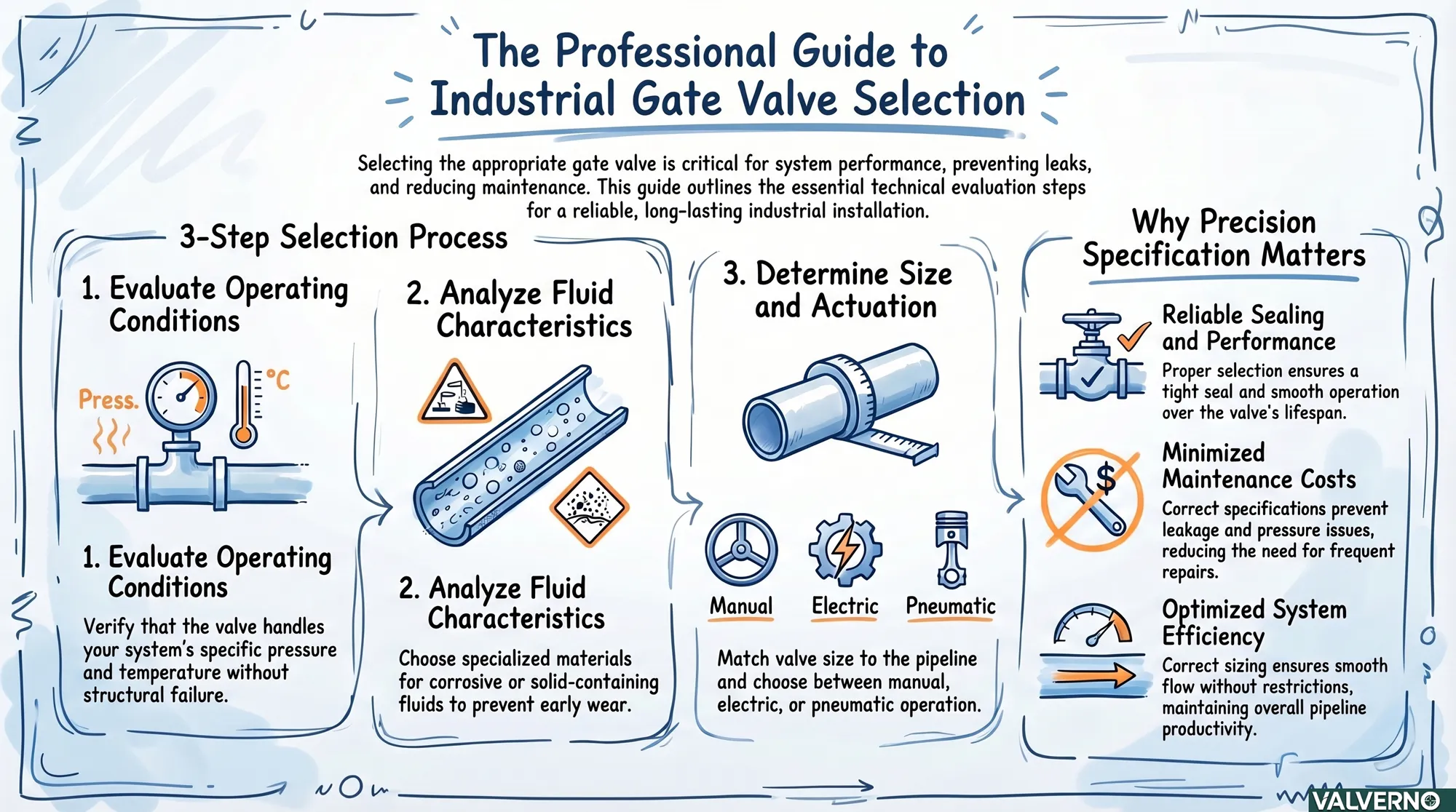
Choosing the right gate valve plays an important role in how well your system performs over time. A properly selected valve will operate smoothly, provide reliable sealing, and reduce the need for maintenance. On the other hand, a mismatch between the valve and working conditions can lead to leakage, pressure issues, or early wear.
Quick Answer
To choose the right gate valve, you should consider pressure, temperature, fluid type, valve size, and installation conditions. These factors directly affect performance, durability, and overall efficiency.
Explanation
Start by checking the operating pressure and temperature of your system. The valve must be able to handle these conditions without losing its sealing performance or structural strength. Next, consider the type of fluid flowing through the pipeline. Clean fluids usually work well with standard gate valves, while corrosive or solid-containing fluids may require special materials or designs.
The valve size should match the pipeline to ensure smooth flow without restriction. Incorrect sizing can reduce efficiency and create pressure problems. It is also important to evaluate the installation space and layout. In limited spaces, a non-rising stem design may be more practical, while rising stem valves are better when visibility and easy maintenance are needed.
Finally, think about the operation method. Manual valves are suitable for simple systems, while automated options such as electric or pneumatic actuators are better for controlled or remote operations.
When all these factors are considered together, you can select a gate valve that works reliably, lasts longer, and supports efficient system performance.
Key Selection Factors
- Operating pressure and temperature
- Type of fluid (clean, corrosive, or containing solids)
- Required valve size
- Available installation space
- Manual or automated operation
Step by Step Gate Valve Selection Process
| Step | Technical Action Description |
|---|---|
| Step 1 | Define operating pressure, temperature, and system conditions |
| Step 2 | Select appropriate material based on fluid compatibility |
| Step 3 | Determine valve size, bore type, and applicable standards |
| Step 4 | Evaluate installation space, layout, and mounting constraints |
| Step 5 | Choose suitable actuation method (manual or automated system) |
How to Choose a Reliable Gate Valve Manufacturer in China?
Finding a reliable gate valve manufacturer in China is not always simple. Many buyers face issues such as inconsistent quality, unclear specifications, delayed delivery, or valves that don’t perform under real working conditions.
At first, everything may look correct on paper but problems often appear after installation.
The real challenge is choosing a supplier that delivers exactly what your system requires, without hidden risks.
VALVERNO Industrial Valve Manufacturer & Supplier in China
Valverno is a trusted industrial valve manufacturer in China, supplying high-quality valves with competitive pricing and reliable global delivery.
With a strong focus on quality control, proper material selection, and consistent production standards, Valverno helps customers avoid common sourcing issues and ensures smooth project execution.
What You Should Check Before Choosing a Manufacturer
Before making a final decision, take time to evaluate the supplier carefully. A reliable manufacturer should be able to:
- Use materials suitable for your pressure, temperature, and fluid type
- Maintain consistent production quality
- Understand real industrial applications
- Provide clear and accurate technical specifications
- Deliver on time without unexpected delays
- Offer both manual and automated valve options
Choosing the right manufacturer is not just about buying a valve—it’s about reducing risk and ensuring long-term performance.
If you want to avoid costly mistakes and ensure your project runs smoothly, our technical team is ready to help.
Contact our sales experts today to get the right gate valve solution based on your exact requirements.
Answered
What is a gate valve used for in industrial pipelines?
A gate valve is used to completely stop or allow fluid flow. It works as an isolation valve, ensuring full shut-off or full flow with minimal resistance.
How does a gate valve work?
A gate valve works by lifting or lowering a gate inside the valve body. When open, fluid flows freely; when closed, the gate seals tightly to stop flow.
What are the main types of gate valves?
The main types include wedge, parallel, and knife gate valves. They differ in sealing method and are selected based on fluid type and working conditions.
What should I check before choosing a gate valve for my system?
You should check pressure, temperature, fluid type, valve size, and installation space. Matching these factors ensures proper sealing, durability, and smooth operation.
Why do some gate valves fail or leak after installation?
Failures usually happen incorrect material selection or mismatch with pressure and fluid conditions. Poor sizing or using the valve for throttling can also cause damage.
How can I make sure I choose a reliable gate valve supplier from China?
Choose a supplier with proven quality control, clear technical specifications, and consistent production standards. Also confirm they understand real industrial applications and can deliver on time.