


Ball Valve Manufacturer in China
Premium ball valves from China delivering reliable flow control, long life, and competitive supply.
Ball Valve — Quick Answer, Selection & Buying Guide (2026)
⚡ Quick Answer (What & Why Choose It)
- Main function: Fast shut-off and flow control with quarter-turn operation
- How it works: A rotating ball opens or blocks the flow path
- Main advantage: Tight sealing with very fast operation
- Best for: Gas, liquid, and systems needing reliable shut-off
- Result: Lower leakage risk + longer service life
⚙️ Types (Choose Based on System Needs)
- Floating Ball: Cost-effective for low to medium pressure
- Trunnion Ball: Better for high pressure and large sizes
- 3-Way / Multi-Port: Used for diverting or mixing flow
- Full Port: Maximum flow with minimal pressure drop
- Reduced Port: More compact and economical design
📌 How to Select the Right Valve
- Fluid Type: Check gas, liquid, corrosive, or chemical media
- Pressure & Temperature: Match valve class to operating conditions
- Material: Stainless, carbon steel, brass, or alloy
- Port Design: Choose full port or reduced port based on flow needs
- Operation: Manual, electric, or pneumatic actuation
💰 Buying Factors & Price Drivers
- Material: Stainless steel and alloys increase cost
- Size: Larger valves require more material and machining
- Pressure Class: Higher ratings mean stronger construction
- Design Type: Trunnion and special designs cost more
- Tip: Compare lifecycle cost, not just purchase price
Are you looking for a reliable ball valve manufacturer in China, but unsure which product or supplier is right for your project? Many engineers and buyers face challenges with leakage, pressure loss, or poor durability—often caused by choosing the wrong ball valve or working with an inexperienced manufacturer.
The reality is that selecting the right ball valve is not just about price. It requires a clear understanding of valve types, materials, pressure ratings, and how each option performs in real industrial conditions. Making the right choice can improve system efficiency, reduce maintenance, and prevent costly downtime.
Valverno is a professional ball valve manufacturer in China, providing dependable valve solutions with stable quality and practical engineering support for industrial applications. This guide is created to help you better understand how ball valves work, how to compare different options, and how to select the most suitable solution for your system.
Keep reading to find clear answers and make a confident, well-informed decision for your next project.
Get technical guides and specs for Ball Valve selection.

What Is a Ball Valve and How Does It Work in Industrial Systems?

A ball valve is a quarter-turn valve that controls fluid flow using a rotating ball with a hole through its center. When the hole lines up with the pipeline, fluid flows freely. When turned 90 degrees, the flow stops completely.
Quick Answer
A ball valve allows fast shut-off and tight sealing by rotating a ball inside the valve body.
How the Mechanism Works
- The ball is connected to a stem and handle or actuator
- Rotating the handle 90° opens or closes the valve
- Seats (seals) press against the ball to prevent leakage
Why Ball Valves Are Widely Used
- Fast operation (quarter-turn)
- Strong sealing performance
- Long service life
- Reliable even after long idle periods
- Suitable for gas and liquid systems
Common Applications
- Oil and gas pipelines
- Chemical processing plants
- Water treatment systems
- Power generation facilities
Types of Ball Valves Explained (Floating, Trunnion, 3-Way, Full Port Designs)
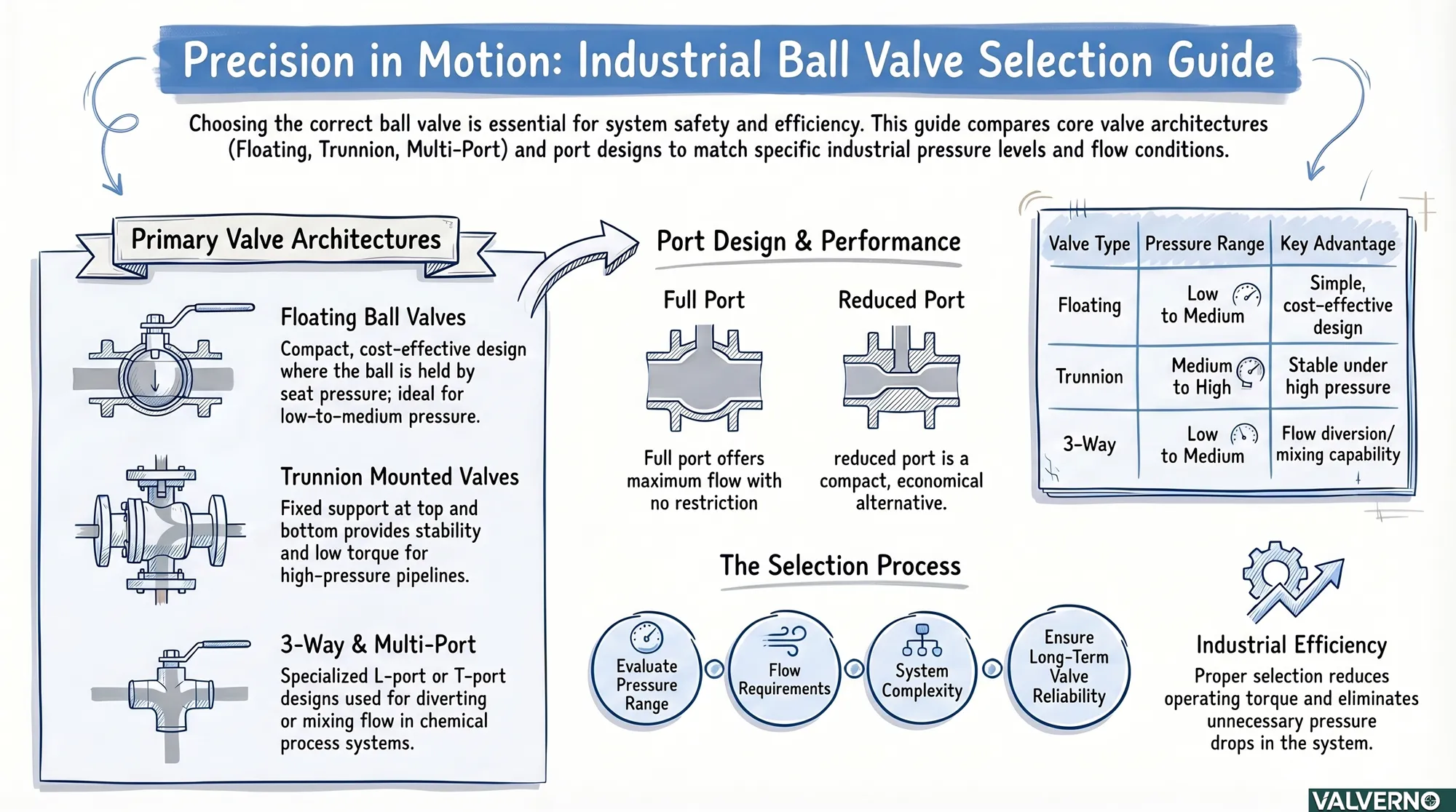
Choosing the correct type is essential because each design fits different pressure levels and system conditions.
Floating Ball Valves
- Ball is held by seat pressure
- Best for low to medium pressure
- Compact and cost-effective
Trunnion Mounted Ball Valves
- Ball is supported from top and bottom
- Designed for high pressure and large sizes
- Requires less operating torque
3-Way and Multi-Port Ball Valves
- Used to divert or mix flow
- Available in L-port and T-port designs
- Common in process systems
Full Port vs Reduced Port
- Full port: No flow restriction, maximum efficiency
- Reduced port: Smaller bore, more economical
Ball Valve Types Comparison:
Choosing the right ball valve type depends on pressure conditions, flow requirements, and system design. The table below gives a clear technical comparison to help you quickly evaluate each option.
| Ball Valve Type | Structure Design | Pressure Range | Key Advantage | Limitation | Typical Application |
|---|---|---|---|---|---|
| Floating Ball Valve | Ball supported by seat pressure | Low to Medium | Simple design, cost-effective | Higher torque in larger sizes | General industrial systems |
| Trunnion Ball Valve | Ball fixed with top & bottom support | Medium to High | Low torque, stable under high pressure | More complex and higher cost | Oil & gas, high-pressure pipelines |
| 3-Way / Multi-Port | L-port or T-port flow paths | Low to Medium | Flow diversion and mixing capability | Not ideal for tight shut-off only | Chemical and process industries |
| Full Port Ball Valve | Bore equals pipe diameter | All pressure ranges | No pressure drop, maximum flow | Higher cost and larger size | Oil & gas, pigging systems |
| Reduced Port Valve | Smaller internal bore | Low to Medium | Lower cost, compact design | Causes pressure loss | General industrial applications |
Ball Valve Price Guide: What Affects Cost and How to Estimate Pricing in 2026
Ball valve pricing depends mainly on material, size, pressure rating, and design complexity.
Key Factors That Affect Cost
- Material (stainless steel, brass, alloy)
- Pressure rating (Class 150–2500)
- Valve size (DN15 to DN1200+)
- Certifications (API, ISO, CE)
- Design type (floating, trunnion, welded)
Hidden Cost Considerations
- Maintenance and lifecycle cost
- Spare parts availability
- Installation complexity
- Downtime risks
Estimated Price Range
| Valve Type | Typical Price |
|---|---|
| Plastic Ball Valve | $5 – $50 |
| Brass Ball Valve | $30 – $200 |
| Stainless Steel Valve | $100 – $1000+ |
| High-Pressure Industrial | $500 – $5000+ |
Ball Valve Materials, Sizes, and Pressure Ratings Explained

The material directly affects durability, corrosion resistance, and compatibility with the working fluid.
Common Materials
- Stainless Steel (304/316): High corrosion resistance
- Carbon Steel: Strong and durable
- Brass/Bronze: Cost-effective for low pressure
- Alloy Materials: Suitable for extreme environments
Standard Size Range
- Small: 1/4″ – 2″
- Medium: 2″ – 12″
- Large: 12″ – 48″+
Pressure Class Overview
- Class 150 → Low pressure
- Class 300–900 → Medium pressure
- Class 1500–2500 → High pressure
Full Port vs Reduced Port Ball Valves: Key Differences
Full port valves offer better flow performance, while reduced port valves reduce cost.
Key Differences
| Feature | Full Port | Reduced Port |
|---|---|---|
| Flow Efficiency | High | Medium |
| Pressure Drop | Low | Higher |
| Cost | Higher | Lower |
| Best Use | Oil & Gas | General Industry |
Ball Valve vs Gate Valve: Key Differences and Selection Guide
Ball valves are faster and seal better, while gate valves are better for full-flow systems.
Comparison Table
| Feature | Ball Valve | Gate Valve |
|---|---|---|
| Operation | Quarter-turn | Multi-turn |
| Speed | Fast | Slow |
| Sealing | Excellent | Moderate |
| Maintenance | Low | Higher |
| Best Use | Shut-off | Flow isolation |
How to Choose the Right Ball Valve for Your Project
Selecting the right valve is a technical decision not just a price comparison.
Step-by-Step Selection Guide
- Identify the fluid (gas, liquid, corrosive)
- Determine pressure and temperature
- Choose the correct material
- Select valve type (floating or trunnion)
- Decide operation method (manual or automated)
Key Engineering Considerations
- Media compatibility
- Leakage requirements
- Frequency of operation
- Environmental conditions
Common Mistakes to Avoid
- Choosing based only on price
- Ignoring pressure ratings
- Using incorrect materials for corrosive fluids
Always consider lifecycle cost, not just purchase price. A cheaper valve may cost more over time due to maintenance or failure.
💡 PRO TIP
How to Choose a Reliable Ball Valve Manufacturer in China
A reliable manufacturer must offer certified quality, strong engineering capability, and consistent production standards.
Key Criteria to Evaluate
- Certifications (API 6D, ISO 9001, CE)
- CNC machining capability
- Quality inspection processes
- In-house testing facilities
Manufacturing Capabilities to Look For
- Precision machining of ball and seat
- Pressure and leakage testing
- Custom design (OEM/ODM support)
Supplier Evaluation Checklist
- Years of industry experience
- Export markets and references
- Technical support availability
- After-sales service
Why China Is a Leading Choice
- Competitive pricing
- Large production capacity
- Advanced supply chain
- Wide product range
Answered
What is a ball valve and how does it work in industrial systems?
A ball valve is a quarter-turn valve that controls flow using a rotating ball with a hole. When aligned, fluid flows; when turned 90°, it stops completely. It provides fast shut-off and tight sealing.
Why should you choose a ball valve for industrial applications?
Ball valves offer fast operation, strong sealing, and long service life. They are reliable for gas and liquid systems and help reduce leakage risk and maintenance needs.
How do you choose the right ball valve for your project?
Start by identifying fluid type, pressure, and temperature. Then select the right material, valve type, and operation method to match your system conditions and performance needs.
What factors affect ball valve price in 2026?
Ball valve price depends on material, size, pressure rating, and design type. Higher-grade materials and high-pressure designs increase cost, so always consider total lifecycle cost.
What is the difference between full port and reduced port ball valves?
Full port valves provide maximum flow with low pressure drop, while reduced port valves are more compact and cost-effective but may cause some flow restriction.
How do you choose a reliable ball valve manufacturer in China?
Look for certifications like API and ISO, strong manufacturing capability, and quality testing processes. A reliable supplier also offers technical support and consistent product quality.