


Control Valves Manufacturer in China
Reliable control valve solutions from China, designed for accurate flow control, long service life, and competitive pricing.
Control Valve — Quick Answer, Selection & Buying Guide (2026)
⚡ Quick Answer (What & Why It Matters)
- Main function: Continuous flow, pressure, or temperature control
- How it works: Adjusts valve position based on control signal
- Best for: Automated systems requiring high precision
- Main advantage: Stable process + accurate control
- Result: Higher efficiency + lower operational risk
⚙️ Types (Choose Based on Control Performance)
- Globe Valve: Highest accuracy for critical control
- Ball (V-Port): High flow capacity + strong shutoff
- Butterfly: Cost-effective for large systems
- Plug Valve: Handles dirty or abrasive fluids
- Tip: Precision vs flow capacity is the key trade-off
📌 How to Select the Right Valve
- Control Target: Flow, pressure, temperature, or level
- Fluid Type: Clean, viscous, or solid-containing
- Pressure Drop: Check cavitation and noise risks
- Actuator: Pneumatic, electric, or hydraulic
- Sizing: Correct Cv is critical for performance
💰 Buying Factors & Price Drivers
- Valve Type: Globe and severe-service designs cost more
- Material: Stainless and alloy increase durability and price
- Actuator & Positioner: Major cost component
- Special Trim: Anti-cavitation, low-noise adds cost
- Tip: Wrong sizing = poor control + higher long-term cost
Are you trying to control flow, pressure, or temperature in your system, but facing problems like instability, cavitation, or poor control accuracy? This is a common issue for engineers and buyers, especially in systems where precise control is critical for stable operation.
In most cases, the solution depends on selecting the right regulating and control valves based on actual process conditions. A control valve must match the system’s pressure, temperature, and flow requirements to deliver accurate and reliable performance over time. Understanding how these valves work, along with their design options and limitations, can help you avoid performance issues and reduce long-term costs. In this guide, you will learn how regulating and control valves function, how to compare different types, what affects pricing, and how to choose the right solution step by step.
As a trusted control valve manufacturer, VALVERNO Industrial Valve Manufacturer in China provides reliable valve solutions with consistent quality and practical engineering support for industrial control applications.
Continue reading to explore clear and practical insights, and confidently select the right control valve solution for your system.
Get technical guides and specs for Regulating & Control Valves selection.

What Are Regulating & Control Valves? Definition, Functions, and Key Differences

egulating and control valves are designed to adjust fluid flow continuously, rather than simply open or close a pipeline.
- Control valve: Works inside an automated control loop
- Regulating valve: A broader term that includes manual, self-operated, or automated valves
👉 In short:
All control valves regulate flow, but not all regulating valves are part of automated systems.
Core Functions
| Function | What It Does |
|---|---|
| Flow control | Maintains a target flow rate |
| Pressure control | Stabilizes upstream or downstream pressure |
| Temperature control | Adjusts flow to manage heat transfer |
| Level control | Regulates liquid levels in tanks |
| Process stability | Responds to system changes |
Key Difference
- Control valves → signal-driven, automated
- Regulating valves → can be manual, self-operated, or automated
- On/off valves → not suitable for continuous control
How Do Regulating & Control Valves Work in Industrial Flow Control Systems?
A control valve adjusts its opening based on a signal from a controller to keep process conditions stable.
Basic Control Loop
| Step | Action |
|---|---|
| 1 | Sensor measures process condition |
| 2 | Controller compares with setpoint |
| 3 | Signal sent to actuator |
| 4 | Valve position changes |
| 5 | Process returns toward target |
Common Actuation Methods
- Pneumatic (3–15 psi)
- Electric (4–20 mA, 0–10 V)
- Hydraulic (heavy-duty systems)
Key Insight
Unlike on/off valves, control valves operate in partial positions to continuously fine-tune the process.
Types of Regulating & Control Valves: Globe, Ball, Butterfly, Plug & More

Control valves are mainly divided into linear motion and rotary motion types.
Main Valve Types
| Valve Type | Motion | Strength |
|---|---|---|
| Globe | Linear | High precision control |
| Ball (V-port / segmented) | Rotary | High capacity, tight shutoff |
| Butterfly | Rotary | Large size, cost-effective |
| Eccentric plug | Rotary | Handles dirty fluids |
| Diaphragm | Linear | Hygienic applications |
| Pinch | Sleeve | Slurry and abrasive media |
Quick Selection Guide
- Globe valve → best for accuracy and severe service
- Ball valve → high flow capacity + strong sealing
- Butterfly valve → large pipelines, lower cost
- Plug valve → dirty or abrasive media
Regulating & Control Valve Price Guide: Key Factors That Affect Cost in 2026
What Affects the Price?
Control valve pricing depends on multiple engineering and configuration factors:
- Valve type (globe, ball, butterfly, etc.)
- Material (carbon steel, stainless, alloy)
- Pressure rating and size
- Actuator type
- Positioner and accessories
- Special trim (anti-cavitation, low-noise)
Cost Levels by Package
| Package Type | Cost Level |
|---|---|
| Basic valve (manual/simple) | Low |
| Standard control valve | Medium |
| With digital positioner | Medium–High |
| Severe service valve | High |
| Custom engineered solution | Premium |
Important Buyer Insight
A lower initial price often leads to higher lifecycle cost due to:
- Poor control performance
- More maintenance
- Energy loss
Key Components of Control Valves: Actuator, Positioner, Trim & Valve Body
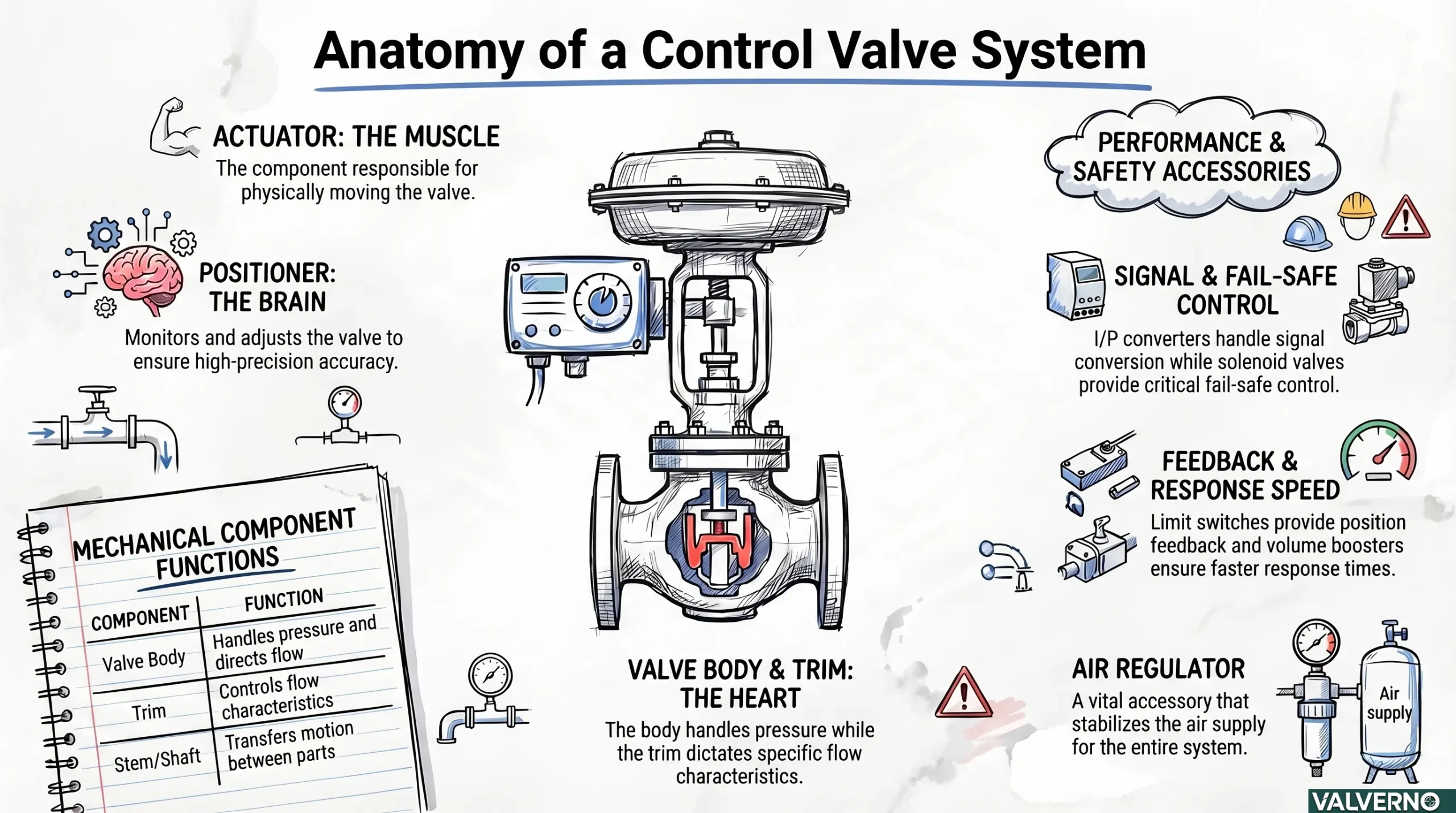
A control valve is a complete system, not just a valve body.
Main Components
| Component | Function |
|---|---|
| Valve body | Handles pressure and directs flow |
| Trim | Controls flow characteristics |
| Actuator | Moves the valve |
| Positioner | Ensures accuracy |
| Stem/shaft | Transfers motion |
| Accessories | Improve performance and safety |
Common Accessories
- I/P converter → signal conversion
- Solenoid valve → fail-safe control
- Limit switch → position feedback
- Volume booster → faster response
- Air regulator → stabilizes air supply
Industrial Applications of Regulating & Control Valves (Oil, Gas, Water & More)
Control valves are used across nearly all industries:
Industry Use Cases
| Industry | Application |
|---|---|
| Oil & gas | Pressure, flow, gas systems |
| Power plants | Steam, feedwater control |
| Water treatment | Flow and pressure regulation |
| Chemical | Reaction and temperature control |
| HVAC | Energy and flow balancing |
| Food & pharma | Hygienic control systems |
What Affects Valve Choice?
- Clean vs dirty fluid
- Pressure drop
- Cavitation risk
- Noise requirements
- Required control accuracy
How to Select the Right Regulating & Control Valve for Your Application
Step-by-Step Selection
- Identify the control variable (flow, pressure, etc.)
- Analyze fluid properties (clean, viscous, solids)
- Calculate required Cv (flow capacity)
- Check for cavitation or noise risks
- Define fail-safe position
- Choose actuator based on available utilities
Practical Checklist
- What is the process goal?
- Is precision control required?
- What are operating conditions?
- Is automation needed?
Common Mistakes
| Mistake | Result |
|---|---|
| Oversizing | Poor control, instability |
| Wrong trim | Damage, noise, cavitation |
| Wrong actuator | Slow or failed operation |
| Ignoring fail-safe | Safety risks |
| Choosing lowest price | Higher long-term cost |
Regulating vs Control Valves: Key Differences and When to Use Each
Quick Comparison
| Term | Meaning |
|---|---|
| Control valve | Automated control loop valve |
| Regulating valve | General flow-adjusting valve |
| Self-operated | Uses process pressure |
| Manual regulating | Adjusted by operator |
When to Use Each
- Control valve → dynamic, automated systems
- Regulating valve → simpler or manual control
- Self-operated → local pressure control without automation
Benefits of High-Performance Regulating & Control Valves in Industrial Systems
High-quality control valves improve overall system performance.
Key Benefits
| Benefit | Impact |
|---|---|
| Better accuracy | Stable process |
| Reduced cavitation | Longer valve life |
| Improved diagnostics | Faster troubleshooting |
| Tight shutoff | Less leakage |
| Higher efficiency | Lower energy use |
Where They Matter Most
- High pressure drop systems
- Continuous operation
- Severe service environments
- Critical process control
How to Choose a Reliable Regulating & Control Valve Manufacturer in China (Complete Buyer’s Guide)
Selecting the right supplier is as important as selecting the valve itself.
Evaluation Checklist
| Factor | Why It Matters |
|---|---|
| Engineering support | Prevents wrong selection |
| Product range | Covers multiple applications |
| Quality control | Ensures reliability |
| Trim capability | Handles severe service |
| Documentation | Required for projects |
| After-sales support | Ensures long-term operation |
Key Questions to Ask
- Can they provide sizing calculations?
- Do they offer trim design support?
- Are accessories integrated or outsourced?
- Can they handle cavitation and noise issues?
- What test reports are available?
Answered
What is the main difference between a regulating valve and a control valve?
A control valve works automatically within a control loop using signals, while a regulating valve is a broader term that can include manual, self-operated, or automated valves used to adjust flow or pressure.
How does a control valve maintain stable process conditions?
A control valve adjusts its opening based on a controller signal, allowing it to continuously regulate flow, pressure, temperature, or level and keep the system close to the target setpoint.
What factors should you consider when selecting a control valve?
You should evaluate the control variable, fluid properties, pressure conditions, required flow capacity (Cv), and risks like cavitation or noise to ensure accurate and reliable valve performance.
What are the most common types of regulating and control valves?
The most common types include globe valves for precision, ball valves for high capacity, butterfly valves for large pipelines, and plug valves for handling dirty or abrasive media.
What affects the price of a control valve?
Control valve pricing depends on valve type, material, pressure rating, actuator, trim design, and accessories such as positioners or anti-cavitation features.
Why is choosing the right control valve manufacturer important?
A reliable manufacturer ensures correct valve sizing, proper trim selection, quality control, and strong after-sales support, which directly impacts system performance and long-term reliability.